
What to do When Your First Launch Fails
My framework to properly re-launch.

You know that feeling right after a launch when absolutely nothing happens?
No spike in signups. No surge in demos. The Slack channel that was buzzing for weeks just goes completely dead. Then your CEO asks a “gentle” but pointed question in the next all-hands meeting. And you’re left sitting there with a positioning doc and a GTM plan that made perfect sense three weeks ago, wondering where the hell it all went wrong.
If you’ve been there, this is for you.
A quiet launch isn’t a failed launch. It’s just an incomplete one. That distinction matters more than you think, and it’s the entire point of this letter.
What is a quiet launch?
It’s the launch where you do everything “by the book,” but the market answers with total silence. You know, when they didn’t even care to try it. Most times, It’s not a failure, it’s just incomplete. It doesn’t always mean your positioning is bad or your product is broken. More often than not, it just means you hit one of these walls:
The audience was too broad: You launched to everyone and reached no one deeply enough to move them. The message was true, sure, but it wasn’t urgent or specific enough for any exact person at an exact moment.
You confused the market: When you’re living inside a product, your internal jargon starts to feel like regular human English. The problem is your audience is hearing it for the first time. What feels intuitive to you lands as utter nonsense to them.
Channel mismatch: You’re grinding on LinkedIn but your buyers are actually searching Reddit. Or you’re blasting email campaigns when they really need social proof before they’ll trust a brand they’ve never heard of. This is the most under-diagnosed killer of a quiet launch.
The timing was off: Sometimes you’re genuinely ahead of the pain. The market doesn’t even realise they have a problem yet, so your shiny new solution feels completely unnecessary.
The execution gap: Customers have a very specific expectation of how they want to solve their pain. If your product doesn’t match that workflow, they’ll bounce, even if the pain is real.
Zero reason to change: Switching behavior has a massive psychological cost, even if your product is free. If you aren’t clearly better or cheaper in a way that matters to them right now, they’ll just stay put.
The pain isn’t real enough: This one hurts to hear. Sometimes the problem you’re solving is just mildly annoying, not agonizing. People might find your app “interesting,” but they won’t pull out a credit card for it.
Diagnosing which of these killed your launch is the entire foundation of your relaunch. Do not skip this bit.
The Product Relaunch Framework
The goal here isn’t a bloated 12-step corporate process. It’s about finding the one lever most likely to unlock traction. If you change everything at once, you’ll never figure out what actually worked.
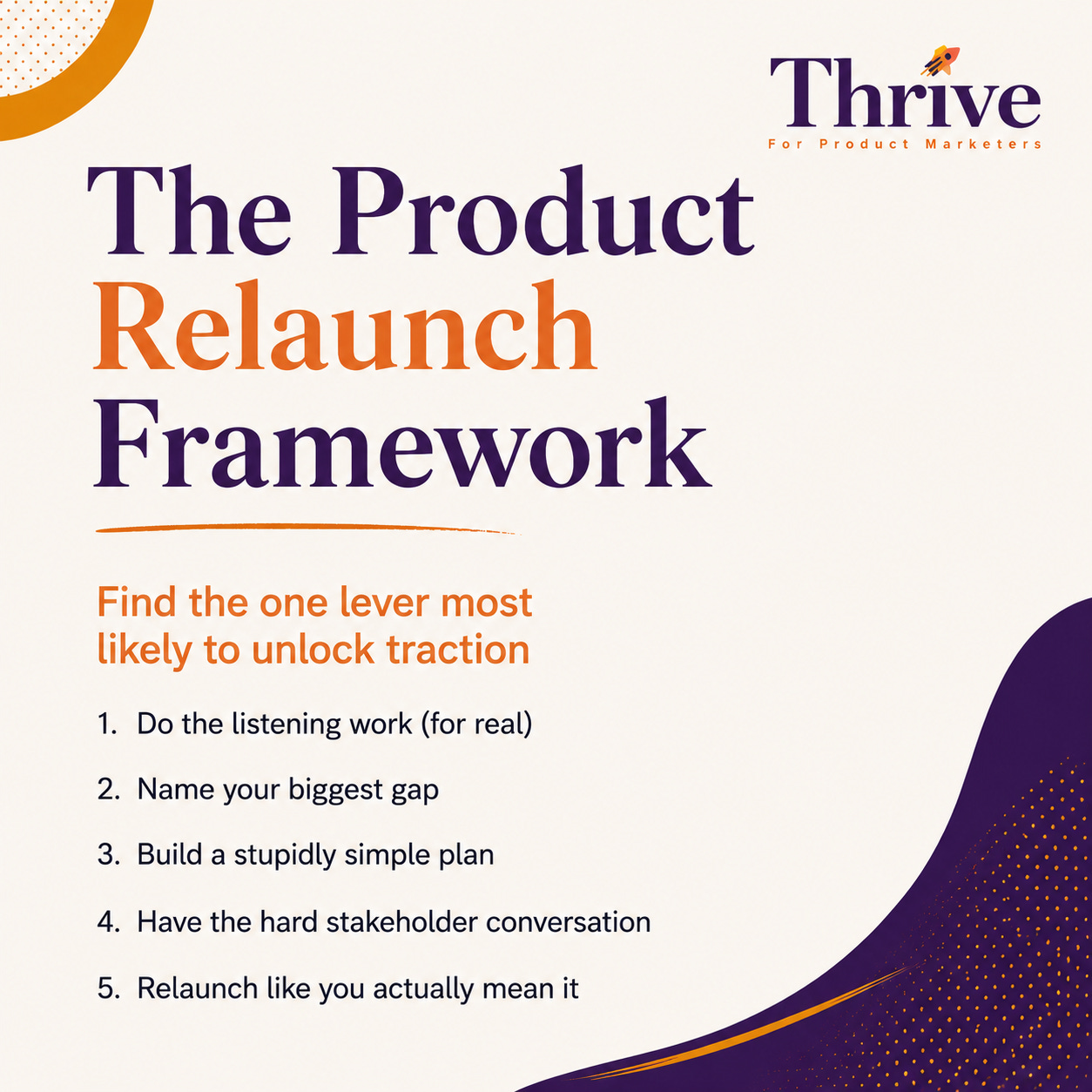
1. Do the listening work (for real)
Before you rewrite a single line of copy, go talk to two groups of people.
First, the people who actually engaged. Even if your launch only grabbed three signups, those three people are absolute gold. Find out what made them stop scrolling. What did they hear? How would they describe what you do to a friend? Their actual language should help you refine your next marketing brief.
Second, the people who saw it and ignored it. This is uncomfortable but vital. Send a quick note asking, “Hey, what did you make of this?” You’ll quickly realise that what you thought you said and what they actually heard are two completely different things. If you can’t exactly trace who these people are, reach out to your ideal target audience and ask them to review and give you feedback. Asking nicely on Linkedin, Instagram, etc… is actually effective. Most will say no or ignore you but a few will say yes and give you the feedback you need.
Give this a week or two of focused effort. The relaunch you build from real customer signals will always obliterate the one built on internal assumptions.
2. Name your biggest gap
Once you’ve done the calls, you need to make a definitive choice on what the core issue was. It usually boils down to one of these gaps:
The strategy gap: This happens when you build your GTM based on popular strategies that may not work for your audience and their behaviour instead of mapping their actual purchase journey. If your target buyers don’t impulse-buy software, and instead rely on checking forums, reading comparison sites, and asking peers for recommendations, then buying a massive budget of Facebook ads is a strategy gap. You are burning money on tactics that don't match customer behavior.
Audience gap: The people who actually care look completely different from the personas you targeted. Your relaunch must narrow the focus down to one hyper-specific segment first that experiences the problem as an emergency, win them over, then expand.
Message gap: This happens when you build your story around your internal solution expectation rather than the customer’s realistic problem.
Inside the company, you describe the product by its functionality (e.g., “An AI-powered, IT Teammate”). But from the customer’s point of view, their problem looks messy, emotional, and specific (e.g., “I am tired of constantly dealing the same IT tickets over and over again”).
When you have a messaging gap, your audience completely misses the point because you’re trying to say too much. The more you try to say, the less you’ll cut through. You have to brutally strip down the complexity. Take the exact words your active users used during your listening phase, put them in the main headline, and anchor your product to their real-world pain point.
Channel gap: You bought the standard SaaS playbook. You set up the LinkedIn ads, fired off the cold email sequences, and scheduled a month’s worth of polished content. And you got absolutely nothing back but crickets. It means your buyers don't actually hang out where the marketing textbooks told you they should. Marketing to them on the wrong platform is just an expensive way to shout into an empty room. If your target audience ignores cold emails but hoards vendor recommendations in private Discord servers, you need to stop burning cash on mainstream ads. Drop the generic multi-channel vanity strategy. Pack up your budget, move it entirely into that one unexpected corner where people are actually talking back to you, and double down until you own it.
Timing gap: This happens because your messaging is selling a vague, high-level benefit ("Save 10 hours a week" or "Streamline your workflow") instead of tapping into a critical, time-sensitive trigger event. Human beings are inherently lazy; we don't buy security software because we love compliance, we buy it because we just failed an audit or have a board meeting in two weeks. If your launch lacked urgency, your relaunch needs to anchor your product to a specific event, a painful organizational milestone, or a structural breakdown in their day-to-day. Stop selling the abstract happily-ever-after. You need to anchor your message to a specific trigger event, not a vague, high-level benefit.
Problem gap: This is the ultimate startup blind spot. You’ve identified an inefficiency in a workflow that drives you completely insane, but your target audience has been dealing with that exact same mess for five years. To them, it’s not a software problem, it’s just how the job is done.
If they don’t consciously recognize the pain, they will never care about your solution. When you hit a problem gap, your entire relaunch needs to take a massive step backward. You have to agitate the friction before you can pitch the feature. Show them the hidden cost of their current manual workaround. Quantify the hours and revenue they are quietly bleeding every single week. You have to make them look at their daily routine and finally realize, “Wait, this is actually broken.” You have to successfully market the problem before anyone will give a damn about your cure.
Differentiation gap: This occurs when customers understand exactly what your product is, but they don’t see a compelling reason to break their current habits. You can layer all the brand storytelling, beautiful UI, and company mission statements you want on top, but it will not convince someone to choose a product that doesn’t offer a clear advantage over what they are already doing. If this is your gap, your relaunch isn’t about explaining your features more clearly. It’s about making the contrast between you and the status quo incredibly sharp, aggressive, and undeniable.
Pick exactly one. This is your relaunch hypothesis.
3. Build a stupidly simple plan
Your relaunch plan doesn’t need to be complex. It just needs to be clear. Write down this exact structure:
“We believe that if we reposition the product for [specific audience] around [specific pain], using [specific channel or message shift], we will see [specific outcome] within [specific timeframe].”
Document what’s changing, what’s staying the same, and why. Set success metrics for week two and week four—and keep them tied to the hypothesis, not vanity metrics.
Then, lock in a hard date. Not “sometime next month.” A real date. Momentum is everything, and every week you drift is a week the team loses faith.
A simple plan around a key hypothesis is also easier for you and other stakeholders to commit to.
4. Have the hard stakeholder conversation
Before you go back into build mode, you need to manage upwards.
If the launch missed, say it plainly. Don’t hide the bad news in a 40-slide deck or dress it up in toxic positivity to cover your tracks. Explain exactly what went wrong, what you learned from talking to users, and what you’re doing to fix it.
This matters for two reasons. First, it preserves trust. Founders and investors can handle a miss; what they can’t handle is a marketer who pretends a ghost town is a success. Second, it shows leadership. Owning the misses makes people trust that you can understand the mistakes made and own it.
Don’t forget to keep other teams in the loop.
5. Relaunch like you actually mean it
Don’t treat a relaunch like a quiet hotfix. It’s a proper launch, so take it just as seriously.
The biggest mistake is quietly swapping out some website copy, sending one email, and posting a vague LinkedIn update saying, “We’ve been listening to feedback and made some changes!” That’s not a relaunch. That’s an edit.
A relaunch deserves the exact same energy as day one, maybe more, because now you have data, which means you have a sharper story. Use it. Brief the team. Update the outreach sequences. Give old visitors a reason to come back. Build fresh creative around the new story.
One last thing
The most dangerous thing about a quiet launch is not the missed metrics. It is what it does to your confidence and your team’s confidence in the work.
It can create a temptation to over-correct, to dramatically change the product or the strategy, when really what was needed was a more focused version of the product story.
Stay close to the data. Stay close to your customers. And trust that a product worth building is worth relaunching until you find the version of the story that makes the right people say “this is exactly what I was looking for.”
Your PMM friend ✌️
Peace