
Roadmap-Style Messaging in 4 Steps
Turn a Product Into a Clear Path to Value

In the last article, I wrote about workflow-level messaging: the step-by-step route your product uses to create a promised outcome. It shows the buyer what happens first, what happens next, what the product does in between, what the user controls or sees, and how those steps lead to the final result.
That lens is useful when the buyer needs to understand how your product works inside a specific process.
But there is another messaging lens I think more startups need to use, especially when the product does more than one thing, supports multiple use cases, or solves a problem that cannot be fixed in one move.
I call it roadmap-style messaging.
Roadmap-style messaging shows the buyer the order in which they should solve a broader problem with your product. It helps them understand where to start, what to solve next, and how each step builds toward the bigger result.
This is different from workflow-level messaging. Workflow-level messaging explains how a specific process works. Roadmap-style messaging explains how value builds.
And that difference is important because many startup websites overwhelm buyers with too much information at once. They present every feature, every use case, every workflow, every dashboard, every integration, and every possible outcome as if the buyer should care about all of them equally.
But buyers rarely enter through the full product vision.
They usually enter through one urgent problem.
A support leader may eventually care about automation, self-service, reporting, customer satisfaction, team performance, and operational efficiency. But their first concern might simply be that customer requests are scattered everywhere and the team keeps missing things.
If your website immediately throws the entire platform at them, you make the product feel bigger than the problem they came to solve. Instead of seeing a clear path forward, the buyer has to figure out the order by themselves.
Roadmap-style messaging gives them that order.
A simple definition of roadmap-style messaging
Roadmap-style messaging is messaging that shows the buyer the recommended path from their first urgent problem to the bigger outcome your product can help them achieve.
It answers a simple question: what should the buyer solve first, what should they solve next, and how does each step create the foundation for the next layer of value?
For example, imagine a customer support platform.
A feature-led message might say: “Manage tickets, automate replies, track customer satisfaction, create help centre articles, and monitor team performance.”
A benefit-led message might say: “Resolve customer issues faster and improve support quality.”
A problem-solution message might say: “Support teams struggle when tickets, knowledge, and performance data are scattered. Our platform brings everything into one place.”
A roadmap-style message would say: “Start by centralising customer requests, then route them to the right person, turn repeated questions into self-service content, and use reporting to improve the support process over time.”
That message does not just prove that the product can do many things. It gives the buyer a path through those things.
They can see the first step. They can see the next step. They can see how the product expands from solving one urgent problem into supporting a stronger support operation.
Roadmap-style messaging gives order to the value
A lot of startup websites assume that showing more value will make the product more convincing. So they keep adding more sections, more use cases, more capabilities, more outcomes, and more proof points.
But value without order can become overwhelming.
The buyer sees that the product is powerful, but they do not know what to do with that information. They do not know which use case matters first. They do not know which feature creates the first moment of value. They do not know whether adoption will be simple or heavy. They do not know how the product moves from “interesting” to “actually useful for us.”
This is the problem roadmap-style messaging solves.
It turns a broad product into a guided path. Instead of saying, “Here are ten things our product can do,” it says, “Here is where to begin, here is what becomes possible after that, and here is how the bigger outcome is built.”
That is a much calmer way to communicate value.
It also makes the product easier to adopt mentally. Before a buyer adopts a product operationally, they have to adopt it in their head. They have to imagine how they would explain it to their team, how they would start using it, what problem they would solve first, and how they would justify expanding from there.
If the website does not give them that path, the buyer has to build it alone.
The 4-step structure of roadmap-style messaging
Roadmap-style messaging works best when the buyer can follow the progression without effort. You are not giving them a product tour. You are giving them an adoption logic.
A clear roadmap-style message usually has four parts:
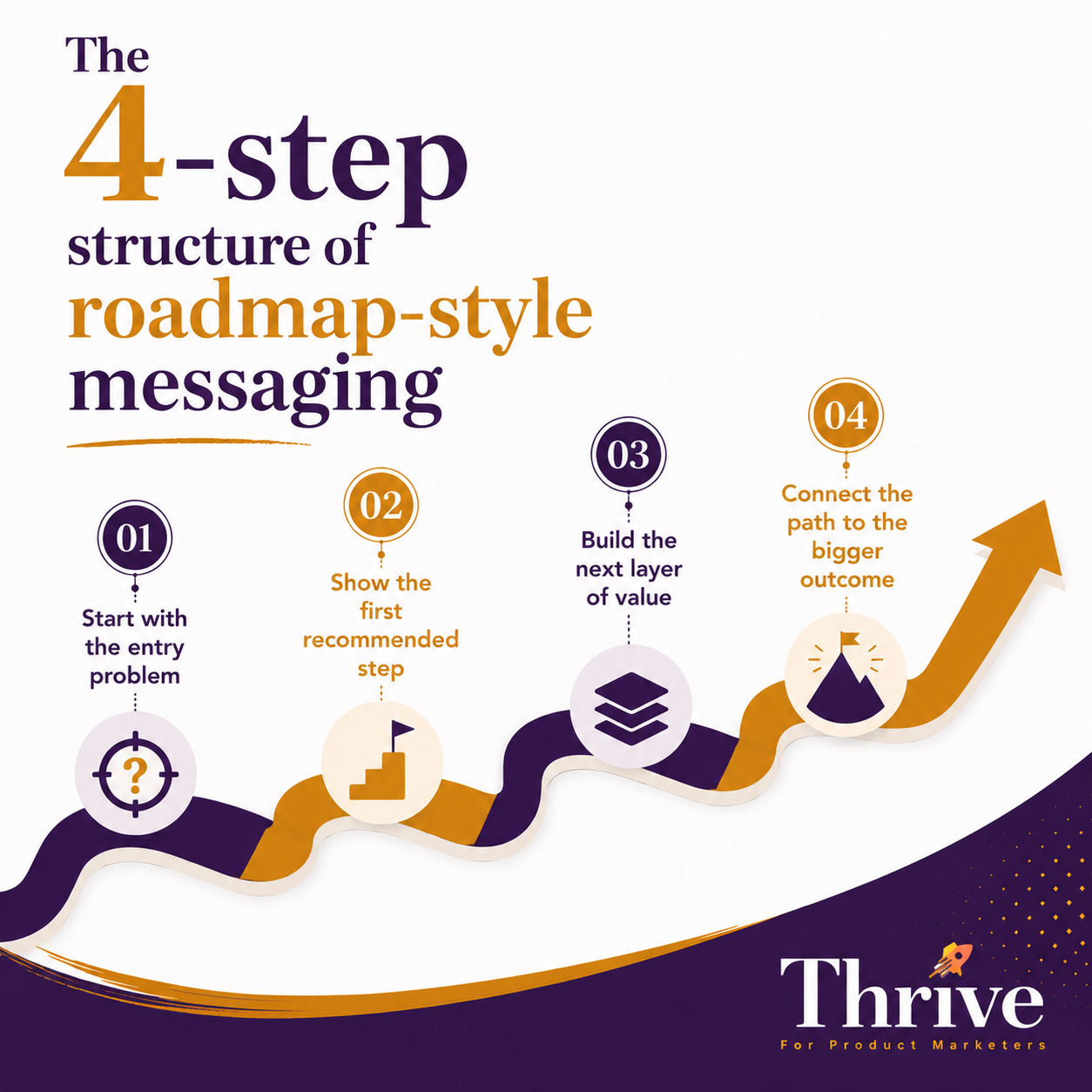
1. Start with the entry problem
The entry problem is the first problem the buyer is most likely trying to solve.
This is not always the full problem your product solves. It is the problem that gets the buyer’s attention first.
For a customer support platform, the entry problem may not be “we need a complete customer experience operating system.” That is too big and too abstract for the first moment of interest.
The entry problem may be much simpler: “Customer requests are coming in from too many places, and the team is losing track of what needs attention.”
That is where the message should begin.
When you start with the entry problem, the buyer does not have to work hard to find themselves in the product. They can immediately see the part of their reality your product is addressing first.
2. Show the first recommended step
Once the entry problem is clear, the next job is to tell the buyer what to do first.
This is where roadmap-style messaging becomes different from ordinary problem-solution messaging. You are not just saying, “We solve this.” You are giving the buyer the first move.
For the customer support platform, the first recommended step may be to bring every customer request into one shared inbox.
That step is logical because the team cannot improve routing, reporting, automation, or response quality if they cannot first see all customer requests clearly. Visibility becomes the foundation.
This is what makes roadmap-style messaging useful. It does not treat every feature as equally urgent. It shows the buyer the order of operations.
3. Build the next layer of value
After the first step is in place, the message should show what becomes possible next.
For the support platform, once all requests are in one shared inbox, the next layer may be routing. Now that the team can see every request, they can start sending the right issues to the right people based on topic, urgency, customer type, or ownership.
This is where the product starts to feel like a system rather than a collection of features.
The shared inbox is not just one feature. It creates the foundation for better routing. Routing then creates the foundation for faster responses. Faster responses create the foundation for better customer experience.
Each step should make the next step feel natural.
4. Connect the path to the bigger outcome
The bigger outcome should feel like the result of the roadmap, not a vague promise added at the end.
For the support platform, the bigger outcome is not just “better customer support.” It is a support operation where requests are easier to track, urgent issues reach the right person faster, repeated questions are reduced through self-service, and the team can use reporting to improve the process over time.
That outcome is easier to believe because the buyer has seen the path that creates it.
Roadmap-style messaging makes the final promise feel earned. The buyer can follow the logic from the first problem to the larger result.
How roadmap-style messaging is different from workflow-level messaging
Workflow-level messaging and roadmap-style messaging are related, but they answer different buyer questions.
Workflow-level messaging answers:
“Does this product solve the problem in the way I need it solved?”
Roadmap-style messaging answers:
“Where do I start, what do I solve next, and how does the value build from there?”
Workflow-level messaging is about the method of solving. It shows the buyer how the product creates the change, so they can judge whether that method fits their expectation, team, process, and reality.
Roadmap-style messaging is about the sequence of adoption or value. It recognizes that buyers often enter with one urgent problem, not the full product vision, so it shows them the right order: start here, solve this first, build on it next, and reach the bigger outcome.
A customer support platform could use workflow-level messaging to show how the product turns scattered customer conversations into a managed support process through inbox capture, routing, ownership, automation, self-service, and reporting. That helps the buyer understand whether the product solves the problem in a way that fits how their team works.
The same platform could use roadmap-style messaging to show that the buyer should start by centralising requests, then improve ownership and routing, then reduce repeated work through self-service, and finally use reporting to improve the support operation. That helps the buyer understand where to begin and how the value builds over time.
When roadmap-style messaging is most useful
Roadmap-style messaging becomes especially useful when the product solves a layered problem.
Some problems cannot be fixed in one step. A support team does not become efficient just because it adds automation. If requests are scattered, ownership is unclear, repeated questions keep coming in, and no one can see the bottlenecks, the problem needs a sequence.
First, create visibility. Then create ownership. Then reduce repeated work. Then improve the process using data.
That is a roadmap.
This lens is also useful when the product has multiple use cases or modules. Without a roadmap, the website can feel like a long menu of possibilities. With a roadmap, the buyer can see how those possibilities connect.
It also helps when the product feels like a big change. Buyers are more likely to engage when they understand that adoption does not have to happen all at once. They can start with the most urgent pain point, get value there, and expand from that foundation.
Where roadmap-style messaging should show up
Roadmap-style messaging belongs anywhere the buyer may need help understanding the path to value.
On the homepage, it can appear as a “how to get started,” or “your path to value” section. The goal is to show the buyer the main journey from first problem to bigger outcome.
On product pages, it can explain how different features build on each other instead of presenting every capability as a separate block.
On use case pages, it can show how to solve one problem in stages. If the use case is poor support visibility, the roadmap might move from centralising requests, to routing ownership, to creating self-service content, to improving team performance with reporting.
On onboarding or pricing pages, it can reduce hesitation by showing what happens first, what happens next, and how long-term value builds.
In sales enablement, it helps internal champions explain the product more clearly. Instead of saying, “This platform has a lot of useful features,” they can say, “We would start by fixing scattered customer requests, then improve routing, then reduce repeated questions, then use reporting to improve the whole support process.”
That is a much easier story to take into an internal conversation.
Final thought
Roadmap-style messaging is useful because buyers do not always need more product information. Sometimes they need a clearer path.
When a product does many useful things, the website has to do more than prove that those things exist. It has to help the buyer understand the order.
Start here. Fix this first. Build on it next. Expand from there. This is the bigger outcome.
That is how roadmap-style messaging gives structure to the value.
It makes a broad product easier to understand, easier to adopt mentally, and easier to explain internally.
And when the buyer can see the path, they are more likely to believe they can take it.
Your PMM friend ✌️
Peace